
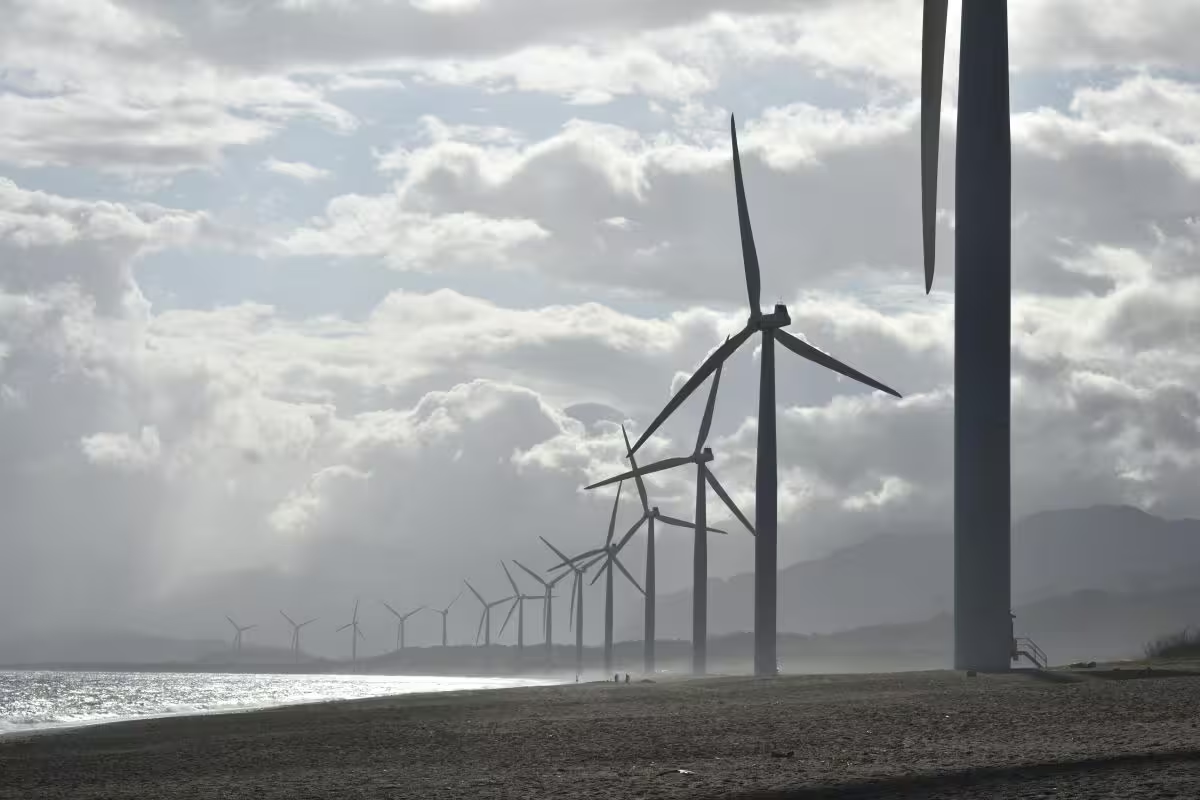
The Latest Advances in Wind Energy: Technology, Policy, and Global Growth
TechnoVita.net
Wind energy continues to be a cornerstone of the global clean energy transition. With climate goals tightening and demand for renewable electricity rising, innovation in wind technology and deployment strategies is advancing rapidly. This article explores the most recent developments shaping the future of wind power — from groundbreaking turbine designs and offshore expansions to digital optimisation and policy support.
A Strong Offshore Wind Rebound
After a temporary slowdown in wind installations, the offshore sector is set for a major rebound. Industry analysts forecast a global addition of about 19 GW of new offshore wind capacity in 2025, marking higher growth than in recent years and signalling renewed investment in large‑scale projects.
Europe, Asia and other regions are accelerating offshore programmes with both fixed‑bottom and floating turbines. Notably, recent UK auctions have allocated record levels of offshore wind contracts — around 8.2 GW for fixed sites and 192 MW for floating wind — positioning the country to reach 36 GW by 2030.
Record‑Breaking and Next‑Generation Turbine Designs
Technological innovation continues to push the boundaries of turbine size and capacity. Major manufacturers are developing ultra‑large turbines, including designs for 50 MW floating units unveiled at international wind power conferences, with rotor spans approaching 290 m.
Onshore, companies are experimenting with high‑power machines that dramatically increase per‑turbine output, offering economies of scale and lower installation costs per megawatt. Such innovations help wind energy remain competitive with conventional power sources.
AI, Digital Optimisation, and Predictive Analytics
Digital technologies are rapidly reshaping wind farm performance and maintenance. Operators are increasingly deploying artificial intelligence (AI) and machine learning to optimise turbine layouts, anticipate mechanical failures and improve energy forecasts. At some sites, AI systems analyse hundreds of data points per turbine every few minutes, cutting downtime and enhancing efficiency.
Advanced wind energy analytics also enable better participation in energy markets and smoother grid integration, supporting real‑time trading and adaptive controls that increase revenue streams.
Sustainability and Circularity in Wind Technology
As the wind industry matures, end‑of‑life issues become increasingly important. Efforts to recycle turbine blades and replace hard‑to‑recycle materials are gaining traction, with manufacturers targeting fully recyclable components by 2040.
This focus on circularity aligns with broader sustainability goals — reducing waste and minimizing the lifecycle carbon footprint of wind installations.
Policy, Investment and Market Dynamics
Government policy continues to influence the pace and scale of wind energy deployment. In Europe, revised renewable energy directives aim to expand wind’s share of the energy mix dramatically by 2030, supported by incentives to stimulate investment and simplify permitting.
However, the industry also faces challenges, such as rising costs and supply chain pressures that have led to workforce adjustments and revised investment plans among major developers.
Regional Projects and Capacity Growth
National and regional initiatives reflect both ambition and complexity. For example, the Netherlands aims to significantly expand wind capacity in the North Sea by 2032, doubling previous targets and pushing innovations in turbine design and park layout.
Despite some delays in development and permitting, these large‑scale projects underline wind power’s central role in national energy strategies worldwide.
Conclusion: Wind Power at a Turning Point
The wind energy sector is in a period of rapid transformation and scaling. From larger turbines and offshore expansion to AI‑driven optimisation and sustainability initiatives, the industry is evolving to meet both economic and environmental demands. With supportive policies and continued technological innovation, wind power is positioned to play an even more dominant role in the global transition to clean energy over the next decade.
You can read all comments, but you must log in to post or reply.
No comments yet. Be the first to react!